The best time to paint your home’s exterior in Arizona is spring, specifically April and May. Once summer temperatures climb above 100°F, paint dries too fast, bonds poorly, and fails early.
For homeowners in Phoenix, Scottsdale, and Chandler, the usable painting window is shorter than most people expect. By mid-June, heat and monsoon moisture make quality application nearly impossible. If exterior painting is on your to-do list, especially if you’re planning exterior painting in Phoenix, the next few weeks are when it needs to happen.
Arizona’s Painting Calendar: Why Spring Is a Small Window
Most of the country can paint exteriors from April through October. In Arizona, extreme heat and monsoon season cut that window roughly in half.
March through May delivers what paint needs to perform: daytime highs in the 70s to low 90s, overnight lows above 50°F, and low humidity. These conditions give paint time to level, bond to the surface, and cure properly before summer stress hits.
By late May, temperatures push toward triple digits. Monsoon moisture can arrive as early as mid-June. The reliable painting window in Arizona is about 8 to 10 weeks, and April and May are the sweet spot.
What Is the Best Month to Paint Outside?
In Arizona, April is the single best month for exterior painting. Temperatures sit comfortably in the 70s and 80s, humidity is low, and there’s almost no rain. May is a close second, though temperatures start climbing toward the upper 90s by the month’s end.
How Often Should You Paint the Exterior of Your House in Arizona?
Most Arizona homes need exterior repainting every 5 to 10 years. Stucco homes in the Phoenix area often last closer to 5 to 7 years because of constant UV exposure. South-facing and west-facing walls fade and chalk faster and may need attention before the rest of the home.
What Happens When You Paint in Arizona Summer (And Why You Don’t Want To)
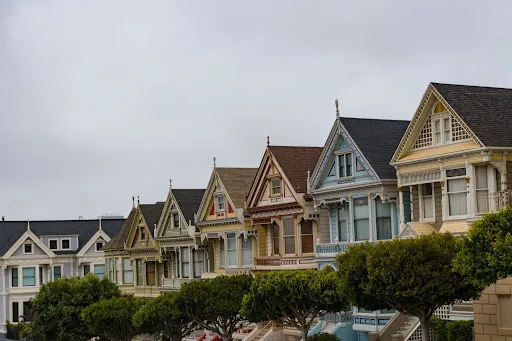
Desert Neutrals
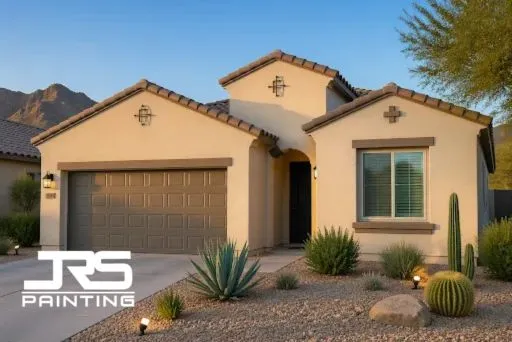
Desert neutrals form the foundation of nearly every approved palette in the Valley. These are the warm, sandy, slightly yellow-leaning tones that echo the surrounding landscape.
Common examples include:
- Soft sand
- Warm khaki
- Classic beige
- Warm taupe
Dunn-Edwards “Weathered Sandstone” and Sherwin-Williams “Accessible Beige” are two widely recognized examples in this family. These colors flatter the typical clay or concrete tile roofs found throughout the Valley, and they hold up well over time.
Southwestern Earth Tones
Earth tones lean a little warmer and a little more saturated than basic neutrals. Think clay, adobe, soft terracotta, and warm cinnamon. These colors are most common in older established communities and in homes built in Pueblo or Santa Fe styles.
Earth tones often appear as accent colors rather than full body colors. Pop-outs, fascia, and entry alcoves painted in a deeper adobe shade can add dimension to a lighter beige body without violating HOA contrast rules.
Modern Gray and Greige Palettes
Newer master-planned communities have embraced cooler grays and soft warm grays. This shift reflects broader design trends and aligns with the contemporary desert architecture popular in Scottsdale, Queen Creek, and parts of Gilbert.
Sherwin-Williams “Agreeable Gray” and Dunn-Edwards “Cliffside” are frequently approved in communities that allow greige body colors. These tones pair well with bronze trim, neutral garage doors, and modern stone veneer.
Approved Trim and Accent Color Combinations
Most HOAs treat body, trim, and accent as three separate approval categories. A typical approved scheme pairs a warm beige body with a slightly darker taupe trim and a deeper bronze or rust accent for the front door.
Common accent applications include:
- Garage doors, which usually must stay within one or two shades of the body color
- Fascia and gutter lines, often painted in the trim color
- Front doors, where HOAs sometimes allow a bolder accent within an approved range
- Shutters, pop-outs, and recessed wall sections that add architectural depth
Some communities require the trim to be lighter than the body, others require it to be darker. The approved palette document will spell this out.
Colors Commonly Rejected by Phoenix HOAs
Certain color choices are nearly universal rejections across Valley HOAs:
- Bright pure white, which reflects too harshly and clashes with the desert landscaping
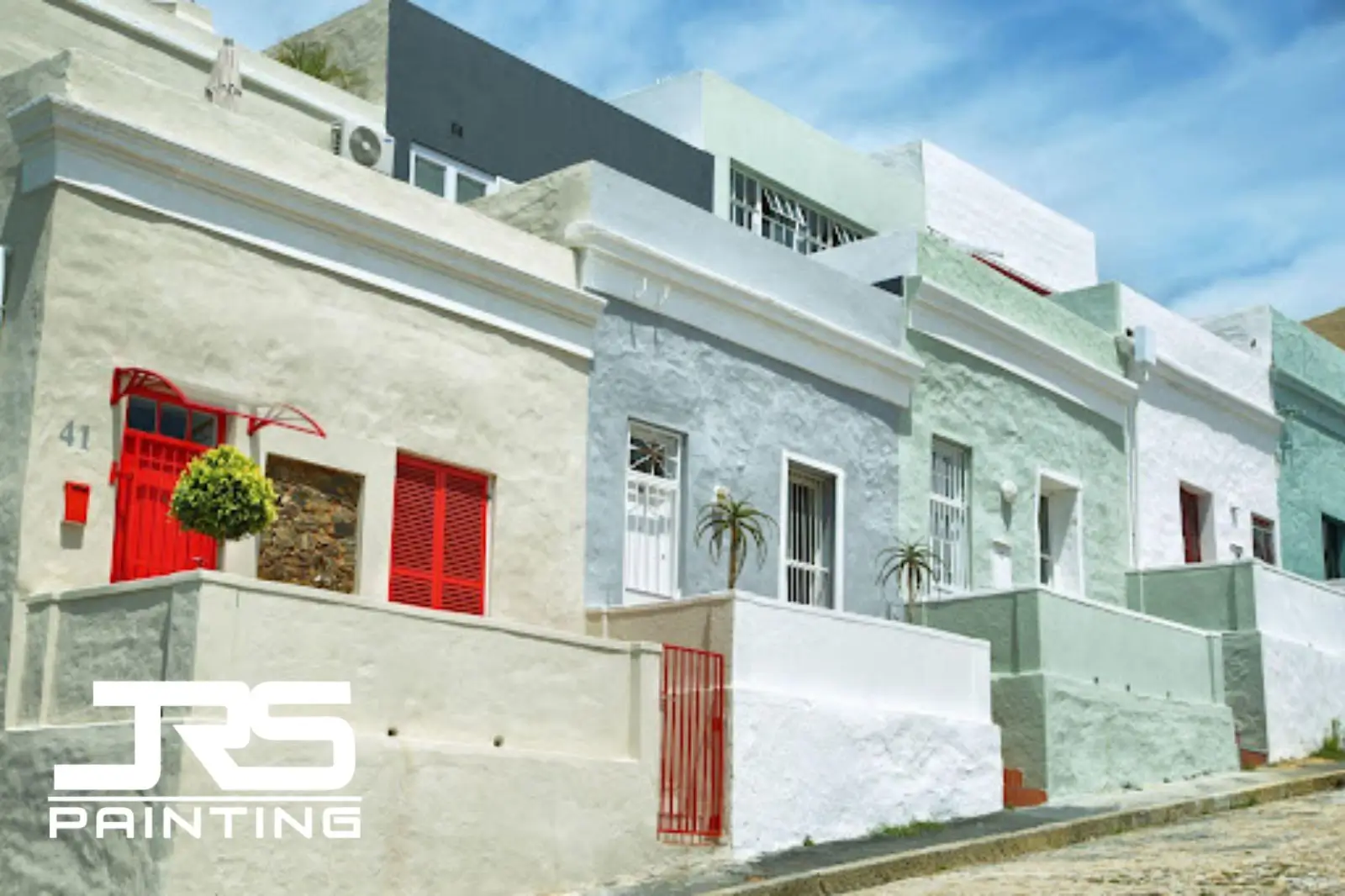
- Cool blue-gray coastal tones that read as out of place in the desert context
- High-contrast black-and-white schemes are more typical of modern farmhouse styles in other regions
- Highly saturated colors like true red, royal blue, or kelly green
- Very dark body colors that absorb excessive heat and fade quickly
A few newer Queen Creek and Gilbert communities have started allowing modern farmhouse palettes, but these remain the exception rather than the rule.
HOA Exterior Paint Guidelines by Major Phoenix-Metro Communities
Ahwatukee HOA Paint Colors
Ahwatukee sits against the South Mountain Preserve, and its HOAs lean heavily into palettes that complement the mountain backdrop. Warm desert neutrals dominate, with soft sand, warm beige, and muted taupe appearing across most approved lists.
Several Ahwatukee communities require body colors that fall within a specific LRV range to maintain the muted mountain-view aesthetic. Accent colors tend to stay in the rust, adobe, and deep bronze family rather than bolder modern accents.
Gilbert HOA Exterior Paint Guidelines
Gilbert has grown rapidly, and its HOA palettes vary significantly by neighborhood age.
Power Ranch tends toward warm traditional neutrals with earth-tone accents. Val Vista Lakes allows a slightly broader range, including some softer greiges along with classic beiges. Seville leans more contemporary, with approved palettes that include modern warm grays alongside the traditional desert neutrals.
Newer Gilbert subdivisions often allow softer, more contemporary palettes than the older sections of town, but accent restrictions remain consistent. Front doors typically must fall within an approved accent list rather than being a free choice.
Chandler HOA Paint Color Trends
Chandler communities tend to favor modern desert tones, particularly in newer developments near Ocotillo and Fulton Ranch.
Ocotillo features waterfront and golf course homes with palettes that include both traditional beiges and updated greiges. Fulton Ranch allows a similarly broad palette with an emphasis on coordinated body, trim, and accent combinations rather than mix-and-match selections.
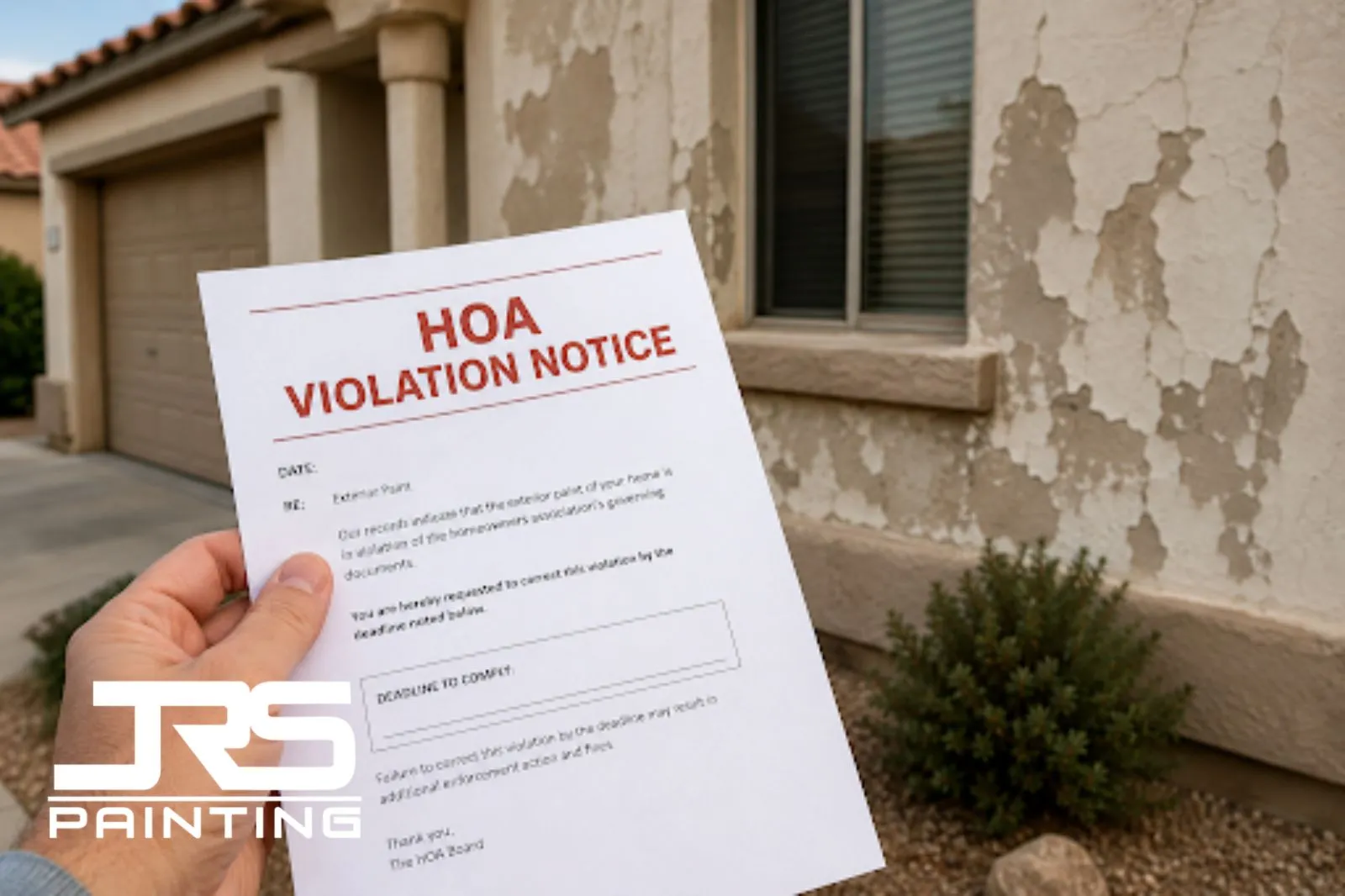
Chandler HOAs commonly enforce a repaint cycle when visible fading or chalking becomes obvious from the street. Homeowners are often required to repaint when the existing color shows significant unevenness.
Scottsdale HOA Exterior Color Preferences
Scottsdale‘s luxury communities maintain some of the strictest exterior paint standards in the Valley.
McCormick Ranch enforces a curated palette of muted upscale neutrals with limited accent variation. DC Ranch uses a tightly controlled palette that aligns with its contemporary desert architecture, with most homes falling within a narrow range of warm taupes and soft greiges. Grayhawk allows somewhat more variety but still maintains strict approval review, particularly for accent and front door colors.
Approval timelines in these communities can run longer than in other parts of the Valley because the review process is more detailed. Many luxury Scottsdale HOAs also require a physical sample painted on the home before final approval.
Mesa HOA Paint Requirements
Mesa‘s HOA communities range from established traditional neighborhoods to newer contemporary developments.
Eastmark is one of the Valley’s largest modern master-planned communities and features a contemporary palette that includes warm greiges and clean accent combinations. Las Sendas leans more traditional, with desert neutrals and earth-tone accents that complement the surrounding desert landscape. Red Mountain Ranch falls between the two, allowing both traditional and updated palettes depending on the specific subdivision.
Peoria and North Phoenix HOA Communities
Peoria and the North Phoenix corridor include several large master-planned communities with desert contemporary palettes.
Vistancia maintains a contemporary palette emphasizing soft warm greiges, muted taupes, and coordinated accent ranges. Fireside at Norterra features modern desert tones with an emphasis on architectural consistency across the community. Norterra more broadly leans contemporary, with approved palettes that reflect the newer architectural style of the area.
Architectural consistency tends to be tightly enforced in these communities, partly because they were built within a relatively compressed timeframe and share a unified design vision.
How to Choose an HOA-Friendly Exterior Paint Color in Arizona
Every color selection should begin with the approved palette document. Most HOAs provide this as a PDF through the management company portal, and many list specific manufacturer codes for Dunn-Edwards or Sherwin-Williams colors.
Architectural review committees compare the submitted color codes directly against the approved list. Choosing a color that “looks similar” to an approved option without matching the exact code is one of the most common reasons for rejection.
Consider Sun Exposure and Direction
West-facing homes take the heaviest afternoon sun in Phoenix and will fade faster than north-facing homes regardless of color choice. Lighter colors and higher-LRV options tend to extend the visual lifespan of a paint job. For more on protecting paint from intense sun, see exterior paint colors for the Phoenix homes.
Heat reflection also matters for energy costs. A lighter exterior reflects more solar radiation, which can slightly reduce cooling loads on the home. This is one reason HOAs in newer energy-conscious communities often require minimum LRV thresholds.
Match Existing Stone, Roof, and Stucco
The paint color does not exist in isolation. It needs to coordinate with the roof tile, any stone veneer, the front entry materials, and the natural stucco texture.
A few quick coordination rules:
- Clay tile roofs in warm terracotta tones pair best with beiges and warm taupes
- Concrete tile roofs in flat gray or charcoal can support cooler greiges
- Stone veneer with strong warm undertones generally clashes with cool gray body colors
Undertone matching matters more than the color name itself.
Test Paint Samples Before Submission
Paint colors shift dramatically between morning and afternoon light in Phoenix. A swatch that looks warm and inviting at 9 a.m. may read washed out and overly yellow by 3 p.m.
Painting large sample squares directly on the home, ideally on two or three different walls with different sun exposure, gives the most accurate read. Digital renderings can be helpful for narrowing options, but should never substitute for actual paint applied to actual stucco.
How Jr’s Painting Helps Homeowners With HOA Paint Approval
HOA Color Consultation Assistance
Navigating an approved palette while balancing personal taste, existing exterior materials, and Arizona sun considerations takes experience. Jr’s Painting has worked across most major Valley HOAs and can help narrow approved options to the ones most likely to satisfy both the committee and the homeowner.
This includes identifying which approved colors tend to age best, which combinations have been frequently approved in the specific community, and which palettes complement the home’s existing roof and stone. Learn more about the company’s Exterior Painting services.
Digital Mockups and Color Recommendations
Visualization helps homeowners commit to a direction before paint hits the walls. Digital mockups can show how a proposed body, trim, and accent combination will read on the actual home, taking out much of the guesswork that comes with paper swatches.
Coordinating body, trim, and accent into a cohesive scheme is one of the most common stumbling blocks during HOA submissions. A well-balanced combination reads as intentional and is far more likely to clear review on the first pass.
Help With HOA Submission Forms
HOA paint approval forms typically require specific information that homeowners may not have readily available, including:
- Paint manufacturer
- Exact color code
- Product line and sheen
- LRV value when required
Pulling this together correctly the first time prevents the most common reason for delayed approvals, which is missing or incomplete submission information.
Professional Repainting That Meets HOA Standards
Approval is only the beginning. The repaint itself has to meet HOA standards for finish quality and consistency, which means proper surface preparation, Stucco Repair where needed, clean trim lines, and a uniform appearance across the full exterior.
A rushed or sloppy paint job, even in an approved color, can trigger a follow-up violation if neighbors complain or the architectural review committee inspects the finished work.
Best Exterior Paint Brands Commonly Accepted by Phoenix HOAs
![Desert Neutrals Desert neutrals form the foundation of nearly every approved palette in the Valley. These are the warm, sandy, slightly yellow-leaning tones that echo the surrounding landscape. Common examples include: Soft sand Warm khaki Classic beige Warm taupe Dunn-Edwards "Weathered Sandstone" and Sherwin-Williams "Accessible Beige" are two widely recognized examples in this family. These colors flatter the typical clay or concrete tile roofs found throughout the Valley, and they hold up well over time. Southwestern Earth Tones Earth tones lean a little warmer and a little more saturated than basic neutrals. Think clay, adobe, soft terracotta, and warm cinnamon. These colors are most common in older established communities and in homes built in Pueblo or Santa Fe styles. Earth tones often appear as accent colors rather than full body colors. Pop-outs, fascia, and entry alcoves painted in a deeper adobe shade can add dimension to a lighter beige body without violating HOA contrast rules. Modern Gray and Greige Palettes Newer master-planned communities have embraced cooler grays and soft warm grays. This shift reflects broader design trends and aligns with the contemporary desert architecture popular in Scottsdale, Queen Creek, and parts of Gilbert. Sherwin-Williams "Agreeable Gray" and Dunn-Edwards "Cliffside" are frequently approved in communities that allow greige body colors. These tones pair well with bronze trim, neutral garage doors, and modern stone veneer. Approved Trim and Accent Color Combinations Most HOAs treat body, trim, and accent as three separate approval categories. A typical approved scheme pairs a warm beige body with a slightly darker taupe trim and a deeper bronze or rust accent for the front door. Common accent applications include: Garage doors, which usually must stay within one or two shades of the body color Fascia and gutter lines, often painted in the trim color Front doors, where HOAs sometimes allow a bolder accent within an approved range Shutters, pop-outs, and recessed wall sections that add architectural depth Some communities require the trim to be lighter than the body, others require it to be darker. The approved palette document will spell this out. Colors Commonly Rejected by Phoenix HOAs Certain color choices are nearly universal rejections across Valley HOAs: Bright pure white, which reflects too harshly and clashes with the desert landscaping Cool blue-gray coastal tones that read as out of place in the desert context High-contrast black-and-white schemes are more typical of modern farmhouse styles in other regions Highly saturated colors like true red, royal blue, or kelly green Very dark body colors that absorb excessive heat and fade quickly A few newer Queen Creek and Gilbert communities have started allowing modern farmhouse palettes, but these remain the exception rather than the rule. HOA Exterior Paint Guidelines by Major Phoenix-Metro Communities Ahwatukee HOA Paint Colors Ahwatukee sits against the South Mountain Preserve, and its HOAs lean heavily into palettes that complement the mountain backdrop. Warm desert neutrals dominate, with soft sand, warm beige, and muted taupe appearing across most approved lists. Several Ahwatukee communities require body colors that fall within a specific LRV range to maintain the muted mountain-view aesthetic. Accent colors tend to stay in the rust, adobe, and deep bronze family rather than bolder modern accents. Gilbert HOA Exterior Paint Guidelines Gilbert has grown rapidly, and its HOA palettes vary significantly by neighborhood age. Power Ranch tends toward warm traditional neutrals with earth-tone accents. Val Vista Lakes allows a slightly broader range, including some softer greiges along with classic beiges. Seville leans more contemporary, with approved palettes that include modern warm grays alongside the traditional desert neutrals. Newer Gilbert subdivisions often allow softer, more contemporary palettes than the older sections of town, but accent restrictions remain consistent. Front doors typically must fall within an approved accent list rather than being a free choice. Chandler HOA Paint Color Trends Chandler communities tend to favor modern desert tones, particularly in newer developments near Ocotillo and Fulton Ranch. Ocotillo features waterfront and golf course homes with palettes that include both traditional beiges and updated greiges. Fulton Ranch allows a similarly broad palette with an emphasis on coordinated body, trim, and accent combinations rather than mix-and-match selections. Chandler HOAs commonly enforce a repaint cycle when visible fading or chalking becomes obvious from the street. Homeowners are often required to repaint when the existing color shows significant unevenness. Scottsdale HOA Exterior Color Preferences Scottsdale's luxury communities maintain some of the strictest exterior paint standards in the Valley. McCormick Ranch enforces a curated palette of muted upscale neutrals with limited accent variation. DC Ranch uses a tightly controlled palette that aligns with its contemporary desert architecture, with most homes falling within a narrow range of warm taupes and soft greiges. Grayhawk allows somewhat more variety but still maintains strict approval review, particularly for accent and front door colors. Approval timelines in these communities can run longer than in other parts of the Valley because the review process is more detailed. Many luxury Scottsdale HOAs also require a physical sample painted on the home before final approval. Mesa HOA Paint Requirements Mesa's HOA communities range from established traditional neighborhoods to newer contemporary developments. Eastmark is one of the Valley's largest modern master-planned communities and features a contemporary palette that includes warm greiges and clean accent combinations. Las Sendas leans more traditional, with desert neutrals and earth-tone accents that complement the surrounding desert landscape. Red Mountain Ranch falls between the two, allowing both traditional and updated palettes depending on the specific subdivision. Peoria and North Phoenix HOA Communities Peoria and the North Phoenix corridor include several large master-planned communities with desert contemporary palettes. Vistancia maintains a contemporary palette emphasizing soft warm greiges, muted taupes, and coordinated accent ranges. Fireside at Norterra features modern desert tones with an emphasis on architectural consistency across the community. Norterra more broadly leans contemporary, with approved palettes that reflect the newer architectural style of the area. Architectural consistency tends to be tightly enforced in these communities, partly because they were built within a relatively compressed timeframe and share a unified design vision. How to Choose an HOA-Friendly Exterior Paint Color in Arizona Every color selection should begin with the approved palette document. Most HOAs provide this as a PDF through the management company portal, and many list specific manufacturer codes for Dunn-Edwards or Sherwin-Williams colors. Architectural review committees compare the submitted color codes directly against the approved list. Choosing a color that "looks similar" to an approved option without matching the exact code is one of the most common reasons for rejection. Consider Sun Exposure and Direction West-facing homes take the heaviest afternoon sun in Phoenix and will fade faster than north-facing homes regardless of color choice. Lighter colors and higher-LRV options tend to extend the visual lifespan of a paint job. For more on protecting paint from intense sun, see exterior paint colors for the Phoenix homes. Heat reflection also matters for energy costs. A lighter exterior reflects more solar radiation, which can slightly reduce cooling loads on the home. This is one reason HOAs in newer energy-conscious communities often require minimum LRV thresholds. Match Existing Stone, Roof, and Stucco The paint color does not exist in isolation. It needs to coordinate with the roof tile, any stone veneer, the front entry materials, and the natural stucco texture. A few quick coordination rules: Clay tile roofs in warm terracotta tones pair best with beiges and warm taupes Concrete tile roofs in flat gray or charcoal can support cooler greiges Stone veneer with strong warm undertones generally clashes with cool gray body colors Undertone matching matters more than the color name itself. Test Paint Samples Before Submission Paint colors shift dramatically between morning and afternoon light in Phoenix. A swatch that looks warm and inviting at 9 a.m. may read washed out and overly yellow by 3 p.m. Painting large sample squares directly on the home, ideally on two or three different walls with different sun exposure, gives the most accurate read. Digital renderings can be helpful for narrowing options, but should never substitute for actual paint applied to actual stucco. How Jr's Painting Helps Homeowners With HOA Paint Approval HOA Color Consultation Assistance Navigating an approved palette while balancing personal taste, existing exterior materials, and Arizona sun considerations takes experience. Jr's Painting has worked across most major Valley HOAs and can help narrow approved options to the ones most likely to satisfy both the committee and the homeowner. This includes identifying which approved colors tend to age best, which combinations have been frequently approved in the specific community, and which palettes complement the home's existing roof and stone. Learn more about the company's Exterior Painting services. Digital Mockups and Color Recommendations Visualization helps homeowners commit to a direction before paint hits the walls. Digital mockups can show how a proposed body, trim, and accent combination will read on the actual home, taking out much of the guesswork that comes with paper swatches. Coordinating body, trim, and accent into a cohesive scheme is one of the most common stumbling blocks during HOA submissions. A well-balanced combination reads as intentional and is far more likely to clear review on the first pass. Help With HOA Submission Forms HOA paint approval forms typically require specific information that homeowners may not have readily available, including: Paint manufacturer Exact color code Product line and sheen LRV value when required Pulling this together correctly the first time prevents the most common reason for delayed approvals, which is missing or incomplete submission information. For a step-by-step look at this process, see [INTERNAL LINK: How to Prepare for an HOA Paint Approval Submission]. Professional Repainting That Meets HOA Standards Approval is only the beginning. The repaint itself has to meet HOA standards for finish quality and consistency, which means proper surface preparation, Stucco Repair where needed, clean trim lines, and a uniform appearance across the full exterior. A rushed or sloppy paint job, even in an approved color, can trigger a follow-up violation if neighbors complain or the architectural review committee inspects the finished work. Best Exterior Paint Brands Commonly Accepted by Phoenix HOAs](https://jrspaintingaz.com/wp-content/uploads/2026/06/HOA-Approved-Exterior-Paint-Colors-in-Phoenix-Metro-HOAs.webp "HOA-Approved Exterior Paint Colors in Phoenix-Metro HOAs")
Dunn-Edwards
Dunn-Edwards is the most widely referenced brand in Phoenix-area HOA palettes. Its colors appear by name and code on the approved lists of most major Valley communities, and the brand maintains palettes specifically curated for HOA use.
Popular Dunn-Edwards colors in Valley HOAs include “Weathered Sandstone,” “Whole Wheat,” “Wooded Acre,” and “Cliffside.” The Evershield product line is formulated to resist UV fading, which extends the visual life of an exterior paint job in Arizona conditions.
Sherwin-Williams
Sherwin-Williams is the second most commonly approved brand and appears on most HOA palette lists alongside Dunn-Edwards. The brand’s HOA-compatible neutrals include “Accessible Beige,” “Agreeable Gray,” “Kilim Beige,” and “Balanced Beige.”
Duration and Emerald exterior product lines offer strong UV resistance and are well-suited to Phoenix conditions.
Behr and Other Approved Alternatives
Behr and other brands are sometimes accepted, particularly when a homeowner can demonstrate that the color exactly matches an approved Dunn-Edwards or Sherwin-Williams code. Some HOAs allow direct submission of any brand, while others restrict approval to the two primary manufacturers.
Checking the specific community’s brand policy before purchasing paint is essential. A color match in a non-approved brand can still be rejected on technical grounds.
Frequently Asked Questions About HOA Exterior Paint Colors in Phoenix
HOA Exterior Painting Done Right in the Phoenix Metro Area
Repainting a home in a Phoenix-Metro HOA community starts with choosing colors that fit the neighborhood, hold up in Arizona’s harsh sun, and complement the home’s existing materials. The right approach helps avoid HOA delays, rejected applications, and costly repainting mistakes.
Jr’s Painting helps homeowners across Ahwatukee, Chandler, Gilbert, Mesa, Scottsdale, Peoria, and surrounding Phoenix communities simplify the process with HOA-friendly color guidance, submission support, stucco repair, and professional exterior painting services built for Arizona homes. Schedule a Free Exterior Painting Estimate or HOA Color Consultation

Related Articles

Exterior Painting, Interior Painting, Residential Painting
-
Exterior Painting, Interior Painting, Residential Painting